
To many of us, road maps are the first things that come to mind when we hear the word "maps." There are, of course, many other kinds of maps, ranging from maps of historical events and time periods to maps of plant and animal habitats, maps of the moon and stars, and even maps of places that exist only in our imagination.
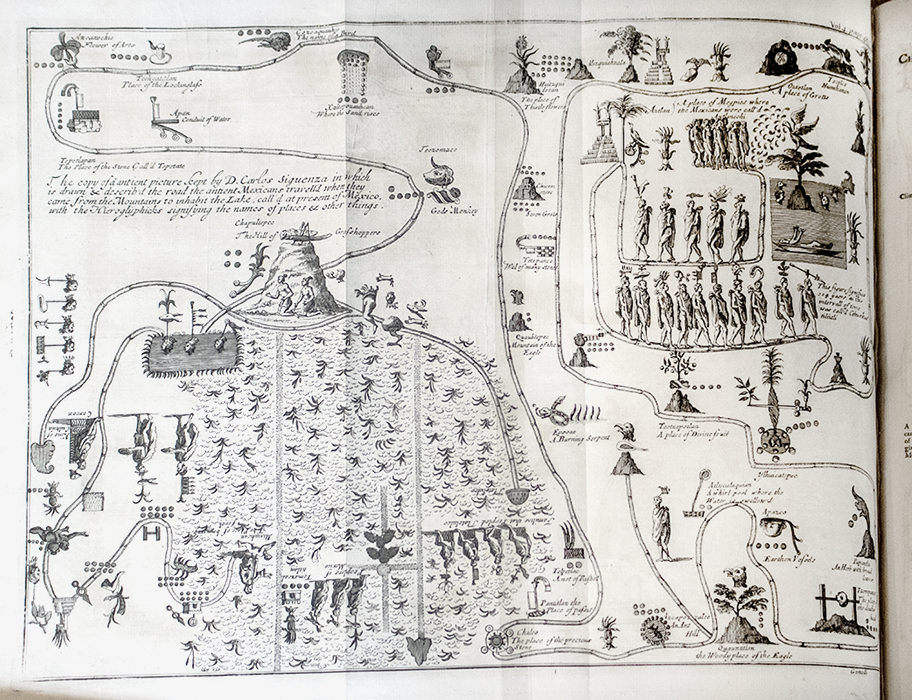
Our "Rare Book of the Month" for February contains a good example of a mythological map. Originally published in 1704 by London booksellers Awnsham and John Churchill, A Collection of Voyages and Travels went through several editions and was expanded over the course of the eighteenth century. UNM's Center for Southwest Research & Special Collections owns a copy of the six-volume, 1744 edition of this popular travel anthology.
Among the narratives found in the fourth volume is an English translation of A Voyage Round the World by Giovanni Francesco Gemelli Careri. Frustrated with his career as a lawyer in Italy, in 1693 Gemelli Careri quit his job and embarked on a life of travel and adventure.
Starting in the Middle East, he eventually arrived in Mexico. More than 150 years after the Spanish conquest of the Aztec capital, Tenochtitlan, Gemelli Careri became fascinated by the story of its founding. According to legend, the god Huitzilopochtli guided the Aztecs from their home in the mountains to the shallow waters of Lake Texcoco, in the middle of which they built an artificial island and founded a new city.
Gemelli Careri retold a portion of the legend in the account of his travels displayed here:
"[Huitzilopochtli] appear’d to [an Aztec priest] in a dream, and told him, the Mexicans must go and settle their abode in that part of the lake where they found an eagle perching upon a fig-tree, whose root was upon a rock. Having told this vision in the morning, they all went together in search of this sign given, and after some time spent, found a fig-tree growing out of a rock, and on it a most beautiful eagle, looking upon the sun, with her wings display'd… Upon this sign they all fell down to pay their adoration, and presently began to build their city, which they call’d Tenochtitlan, that is, fig-tree on a rock."
A map of the legend was included in the account. Said to be a copy of "an antient picture kept by D. Carlos Siguenza," it tells the complete story of the Aztecs' journey and shows many of the mythological creatures they encountered along the way.
Michael Taylor, Public Services Librarian
0 Comments.