
 One of the most powerful volcanic events in recorded history was the April 1815 eruption of Mount Tambora on the Indonesian island of Sumbawa. For months, the volcano spewed clouds of dust into the atmosphere, resulting in dark, cold, incessantly rainy weather and bright but eerie sunsets as far away as Europe. Failed harvests led to famine, meaning that death was far-reaching, too. Conditions were so abnormal that 1816 was nicknamed the "Year Without a Summer."
It was against this backdrop that an icon of horror fiction was born. Over the course of three gloomy evenings in June 1816, eighteen-year-old Mary Shelley—then known by her maiden name, Mary Godwin—went with her future husband, poet Percy Bysshe Shelley, to a villa on the shore of Lake Geneva in Switzerland, where they were traveling on holiday. The house was being rented by Shelley’s friend and fellow poet, Lord Byron. As the group sat around a log fire reading German ghost stories, Byron challenged each of his guests to write their own tale of the supernatural.
Byron and Shelley’s stories didn’t amount to much. John William Polidori, Byron’s personal physician, who was among the guests, began writing The Vampyre, a short story that spawned the nineteenth-century craze for vampire fiction and inspired Bram Stoker’s 1897 novel Dracula. It was Mary Shelley, however, who had the greatest success. Although she initially struggled to come up with a storyline, she dreamed one night about a young Swiss scientist obsessed with the idea of creating life, only to see his experiment go horribly wrong. The dream developed into a short story and the short story into a novel, which she published in 1818 as Frankenstein, or The Modern Prometheus.
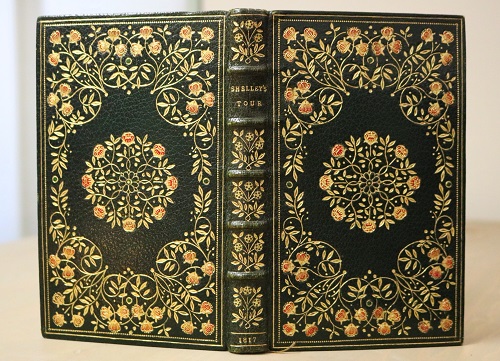
Our "Rare Book of the Month" for October makes a nod to Halloween and celebrates the bicentennial of Frankenstein’s birth. History of a Six Weeks' Tour through a Part of France, Switzerland, Germany, and Holland was co-authored by Mary and Percy Shelley and published in 1817. The book recounts their travels in Switzerland during the volcanic winter of the previous year, when Mary conceived of Frankenstein. Containing descriptions of Gothic ruins and landscapes, as well as personal reflections on human nature in the context of the French Revolution and changing ideas about religion, the book provides insight into the origin and meaning of the world’s first great work of science fiction.
Although the Shelleys wrote in their preface that "Nothing can be more unpresuming than this little volume," this individual copy of the History of a Six Weeks' Tour was elaborately bound by C.B. Lawrence and shown at an exhibition of the Arts and Crafts Society held at the New Gallery in London in 1910. It will be on display, among other books, in the library’s upcoming Collections in Focus event, "Bound to Please: Fine Bindings from UNM’s Special Collections," on November 22, 2016, from 1-2 p.m. For more information, please contact Michael Taylor, Public Services Librarian, at mtaylor6@unm.edu.
0 Comments.